
French ESG software market: consolidation, market leaders strengthening their positions, and strong trends over the next three years.
AdVaes announces the release of the 2026 edition of its benchmark study on ESG software, carbon footprint assessment and IT impact assessment. Unique on the French market, the full report (over 140 pages) is available on request. It includes an analysis of 105 software providers, a review of strategic developments, two quadrants positioning them, and the results of a satisfaction survey conducted amongst 100 C-level executives, along with the associated trends.
The 2026 edition of the benchmark study conducted by AdVaes takes place against a complex backdrop characterised by a general slowdown in projects dedicated to CSR and responsible digitalisation (RD). Nevertheless, the fundamentals remain in place within large organisations, whilst the initiatives of SMEs are stalling. Consequently, the organisations that responded to the satisfaction survey are predominantly large and medium-sized enterprises. In total, more than 2,000 C-level executives were surveyed between February and the end of April 2026, with 100 responses analysed. As for the 105 software publishers, the picture is characterised by mixed responses. There are many reasons for this: staff turnover within these companies, a difficult situation for some, a phase of mergers or consolidation leading to a ‘quiet period’, a change of shareholder, or a deliberate decision not to respond.
All these factors underscore the even greater importance of having a neutral and independent benchmark studythat delves into the specific characteristics of the French market, one that is robust in terms of methodology and approach, combining an in-depth analysis of software providers with feedback from customers using their solutions. Among the key points to note for this 2026 edition are:
➜ A market undergoing contraction and consolidation.
Nearly 10 per cent of the more than 100 CSR/ESG software providers identified by AdVaes in 2025 were subject to an acquisition, a merger or compulsory liquidation. Between 2025 and 2026, the growth in these software providers’ workforce has stalled (+0.3 per cent), following more than four years of continuous double-digit growth. AdVaes estimates the market for software and associated services in France at 230 million euros. Down slightly (-1.0%), it will remain at €230 million in 2026, before returning to moderate growth from 2027 onwards. Its annual growth was sustained until 2024, before beginning to slow from 2025 (+6.3%).
➜ Customer satisfaction is improving but remains uneven.
The overall level of satisfaction with these software providers remains high, with 77 per cent of C-level executives surveyed satisfied or very satisfied with the CSR/ESG software used (compared with 74 per cent in 2025). However, the Net Promoter Score (NPS) has deteriorated slightly, standing at -2. It stood at 15 in 2025. This decline in the NPS may be due to the difficulties encountered by some software providers in adapting their solutions to meet expectations regarding integration and interoperability, data export and collection, and advanced use of AI, as well as perceived return on investment (ROI). These indicators indeed show average satisfaction scores of less than 3.4 out of 5.
➜ A highly diverse market.
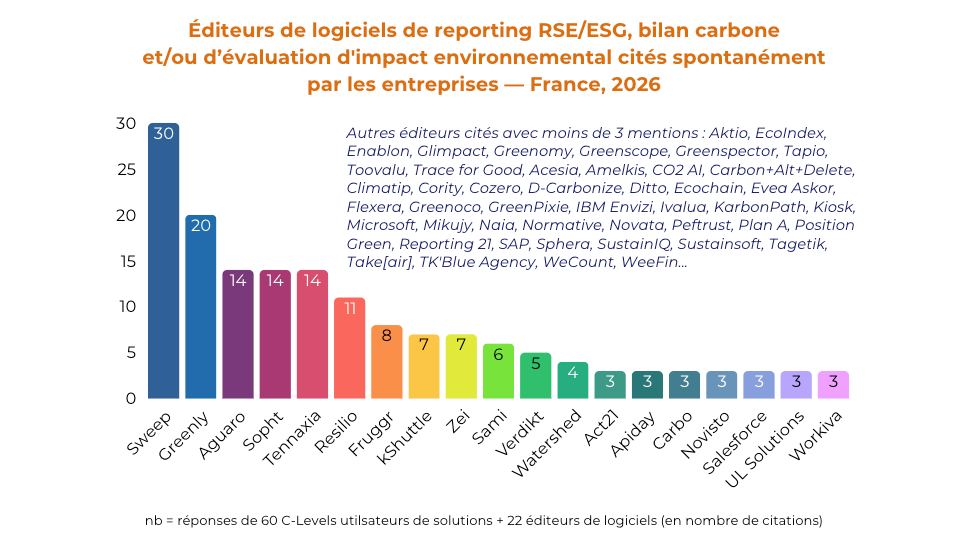
The study confirms the diversity of solutions currently available on the market, with some software providers standing out whilst others struggle to make a breakthrough or are less visible (more low-profile approach, specialisation, niche segment, etc.). The rise of new foreign entrants, who were rarely or never mentioned in previous years’ studies, is also evident in these results. The diagram below shows the software providers that received at least three mentions during the interviews conducted*.
➜ Distinctive positioning to better identify market leaders.
AdVaes has developed a methodology to position these software providers in relation to their solutions, their technological maturity, and their economic and market environment. This approach enables the relative strengths of these software providers and their solutions to be compared on the basis of objective criteria. This methodology feeds into scorecards and positioning quadrants. It is based on two dimensions:
- A “market score”, which assesses 70 common criteria—regardless of the solutions’ intended purpose—and market-related aspects (brand awareness, year-on-year growth, etc.).
- A “product score” or assessment of the solution itself, ranging from its functional coverage to regulatory compliance, including interoperability and integration capabilities, data collection mechanisms and the quality of visualisations. This is based on 41 criteria for CSR/ESG reporting and carbon footprint solutions, and 59 criteria for IT impact assessment solutions.
AdVaes thus identifies four categories of CSR/ESG software providers:
- Leaders have a comprehensive, feature-rich offering, as well as a strong market share and competitive position. They drive innovation and set the direction for the market.
- Challengers have a robust offering, though less extensive in terms of geographical reach and functionality. They have a lower profile. They focus on specific target segments and have room for improvement.
- Followers tailor their offerings to market trends, sometimes adopting an opportunistic approach. However, their profile may be high due to the volume of business they generate. Depending on their size and business model, they may have greater or lesser scope for improvement.
- Niche Players lag behind the most mature offerings on the market. Their offering generally targets a market niche or a specific sector (such as carbon).
The associated quadrants, presenting the results for software providers who fully completed the assessment grid submitted by AdVaes and agreed to participate in the exercise in a fully transparent manner, are available on request.
By helping to clarify the offerings, compare approaches and distinguish between software providers on the basis of solid and robust criteria, AdVaes aims to support CSR/ESG initiatives. This benchmark study, unique in its approach, also serves as a useful reference point for all stakeholders in this ecosystem.
➜ Key trends over the next three years.
Analysis of the differentiating factors in the 2026 roadmaps of the software providers examined reveals an integrated and operational vision of the proposed solutions, with a dual priority: AI as a central driver and the systemic integration of processes, data and tools into the approaches. AdVaes also notes, alongside the structuring of the market, a shift towards integrated platforms and the verticalisation of solutions, an appetite for tool-based consultancy, a growing demand for compliance audits (of the reports, assessments or measurements that this software enables), and an intensification of international development.
AdVaes would like to thank Motherbase, a global database dedicated to innovation, whose data was used to review the strategic developments of 30 software publishers. Fully updated every month, Motherbase enables users to search for and track start-ups and high-growth companies worldwide, and to identify innovation trends by sector. Data collection and analysis are fully automated and optimised by AI algorithms and RPA.
👉 To access the full version (+140 pages — table of contents below) and receive customised reports, please contact us.
* The publishers cited and analysed in this study include: Act21, Aguaro, Aktio, Amelkis, Apiday, Ascend Tech, BlueKanGo, Carbo, Carbon+Alt+Delete, Climatip, Clarity AI, Cority, Cozero, D-Carbonize, Ditto, Ecochain, Enablon (Wolters Kluwer), Evea Askor, Fletchr, Flexera, Fruggr (Digital4better), Glimpact, Greenly, Greenoco (Dcarbo), GreenPixie, Greenscope, Greenspector, IBM Envizi, Kabaun, Karbonpath, Karomia, Kiosk, kShuttle, Microsoft, Normative, Novata, Novisto, Plan A, Position Green, R3, Reporting 21, Resilio, Salesforce, Sami, SAP, Sopht, Sphera, SustainIQ, Sustainsoft, Sweep, Tagetik (Wolters Kluwer), Take[air], Tapio, Tennaxia, Toovalu (Lefebvre Sarrut), Verdikt, Watershed, WeCount, Workiva, Zei...
If you enjoyed this analysis, please feel free to share it.